Spirit Daily
__________________________________________
Uncertainly Remains On How Open
the Benedict Vatican Will Be the Supernatural
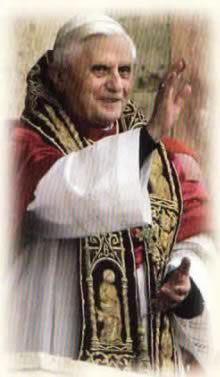 The
liberal media is hoping that Pope Benedict XVI will stray far enough from the
supernatural roots of the Church (its "mystical body") to fall into worldliness.
They are at high dungeon in their belief that a mystical sense was what led John
Paul II to stand unflinchingly against such things as abortion, homosexuality,
and euthanasia. And now they are hoping that Benedict XVI, as a rationalist,
will be more compromising.
The
liberal media is hoping that Pope Benedict XVI will stray far enough from the
supernatural roots of the Church (its "mystical body") to fall into worldliness.
They are at high dungeon in their belief that a mystical sense was what led John
Paul II to stand unflinchingly against such things as abortion, homosexuality,
and euthanasia. And now they are hoping that Benedict XVI, as a rationalist,
will be more compromising.
That won't happen (he will not be
"worldly," and already has affirmed as much), but there are questions about how
he will differ in his treatment of the supernatural. His predecessor and former
boss, John Paul II, was very open to it. He was more mystical than intellectual
(although he was plenty intellectual). Will Benedict XVI prove to be the
opposite?
The issue pushed itself to the
fore last weekend when an Italian news agency, quoting a priest it would not
name, claimed that a short time before he was elected Pope -- when he was still
prefect of the Sacred Congregation for the Doctrine of the Faith (which oversees
miraculous claims) -- Benedict XVI made negative remarks about the most famous
of the current supernatural claims, Medjugorje in Bosnia-Hercegoivina (which
even next week will be the focus of a NBC "Dateline" presentation).
It was a startling and
questionable report in that the Pope, when he was Cardinal Joseph Ratzinger,
prevented Medjugorje from being rejected by a local bishop.
But if there is any credence to
be placed in such a news item, the question would become whether the Pope, when
he was prefect, was simply acting under the behest of John Paul II, a Medjugorje
supporter, when, as prefect, he defended the site of apparitions, or whether he
too had a positive view and has changed his position.
The other
option, of course, and perhaps even the likeliest, is that the news
report was simply erroneous. Thus far, the news agency, AFB Worldwide, has not
responded to our request for substantiation of the quotes from the curiously
anonymous priest. What is certain is that the liberal faction of the
Church is now openly hoping that Benedict XVI will be less mystical than John
Paul II -- and, like AFB, some are already reporting it as a fact.
Christian Weisner, chairman of
"We Are Church" -- an international movement that among other things promotes
the idea of female priests -- was quoted by AFB as saying that the new Pope
shuns the kind of "outpourings of popular religiosity" that the former pontiff
encouraged. "He is dominated by the theology of Augustine and Thomas Aquinas,
and Greek philosophy regarding the body and soul," Weisner asserts in the same
article, adding that Benedict XVI is "in no way" a mystical man.
Author
John Cornwell, who lambastes John Paul II for his mysticism (the visits to
Lanciano, the focus on Fatima, the belief in a coming huge event), feels or at
least hopes the same way.
"He is no supernatural Pope,"
claims Cornwell, a vitriolic anti-Catholic author, in the current issue of
Vanity Fair. "It was Cardinal Ratzinger who, after the announcement of the
third part of the secret of Fatima in May 2000, published a commentary
distinguishing between the meaning of public revelation, to be found exclusively
in Scripture, and private revelations, the prophecies and apparitions of
seers... Whatever Joseph Ratzinger's drawbacks may be, that message emphatically
redefines the papal office after the 26-year reign of the mystical super-Pope."
In fact, Cardinal Ratzinger
indeed had indicated more skepticism to the supernatural than did his
predecessor, but just this week the new pontiff asked Catholics to focus their
attention on the May 13 anniversary of the first Fatima apparition.
In his commentary on the third
secret, Pope Benedict had said that "private revelation is a help to this faith,
and shows its credibility precisely by leading me back to the definitive public
Revelation." Quoting St. Paul in the first letter to the Thessalonians, he noted
that Christians are told not to despise prophecy, but to "test everything,
holding fast to what is good" (5:19-21). That is the oldest of Paul's letters.
More, the
Pope has said that "interior vision does not mean fantasy, which would be
no more than an expression of the subjective imagination. It means rather that
the soul is touched by something real, even if beyond the senses."
It is for this reason, stated the
future Benedict XVI back five years ago, in his third-secret commentary, that
visions are often granted to children: because they are clearer vessels for
heavenly transmission.
"Interior vision is not fantasy
but, as we have said, a true and valid means of verification," he stated in 2000
-- adding that "the history of the entire century" could be represented in the
image in the
Fatima prophecy, which was not so much a
photographic detail of future events as much as a synthesis of situations "in an
unspecified succession."
Clearly, Joseph Ratzinger
believes in the famed third secret. He also noted that private revelation, as in
the case of Corpus Christi, has affected the liturgy itself. The charism
of prophecy is to be scrutinized, he said, "not scorned."
But at the same time, Cardinal
Ratzinger emphasized that a good Catholic did not have to accept private
revelations (that is, any revelation since the time of Scripture), and warned
about prophecies that were overly predictive and don't promote "faith, hope, and
love." In fact he said that the definition of prophecy is not to foretell future
happenings so much as to proclaim the truth of current times, convey the Will of
God for the present, and thus to show the correct path to the future. "A person
who foretells what is going to happen responds to the curiosity of the mind,
which wants to draw back the veil on the future," he stated -- somewhat in
divergence from John Paul II. "The prophetic word is a warning or a consolation
or both together," he said, adding that "signs of the times" have to do with
recognition in every age of Jesus.
And, referring to Fatima and the
famous miracle of October 13, 1917, there was this interesting passage in Pope
Benedict's book, God and the World: "Whatever happened or did not happen
on that October thirteenth, from a purely scientific point of view, we have no
way of knowing for certain. What matters is that the people were visibly moved
by the unique experience of that moment. They were able to realize, something is
happening. And in some way or other the sun became for them a sign of the
mystery that lies beyond it."
Did he have any personal
questions about the great sun miracle? Or was he simply describing the
non-physical workings of the mystical? Does he believe in Medjugorje? Does he
believe or disbelieve in other claims to the supernatural at places such as
Akita in Japan and Garabandal, Spain?
As prefect of the Sacred
Congregation. Cardinal Ratzinger not only oversaw the preservation of Medjugorje
-- which he monitored, and reportedly visited incognito -- but also allowed the
approval or partial approval of apparitions such as Betania in Venezuela, Cuapa
in Nicaragua, Kibeho in Rwanda, and Amsterdam in Holland -- the latter
apparitions that had been rejected by previous bishops and even warned against
by previous administrators at the Vatican itself.
Reports
are that Pope Benedict's successor as prefect of the Congregation will be
Archbishop William J. Levada of San Francisco. Our correspondents there tell us
that Archbishop Levada has been cautiously friendly to claims of the
supernatural. "He is very open to apparitions," says one source who has
sponsored Medjugorje-style events in the area.
"He holds to the correct position
of the Congregation, that Medjugorje is still open, but that official
pilgrimages led by priests, which could appear to have an anticipated positive
decision, are forbidden," says another lay activist in that area. "He published
a number of years ago, in our archdiocesan newsletter, that people were free to
go as individuals."
Still, the
questions remain. If Archbishop Levada becomes prefect, will he maintain
that position on apparitions, or will Pope Benedict stiffen his own views and
translate that down to the new prefect?
Levada, who worked on the Vatican
staff of the Congregation for the Doctrine of the Faith from 1976 to 1982, has
an intimate understanding of the issues facing the U.S. Church, having served as
the Archbishop of Portland from 1986 to 1995, and since then as the Archbishop
of San Francisco. He is thus well-acquainted with the eruption of mysticism in
the America, from visions and locutions to weeping statues.
If he becomes prefect, he will
now have a great effect on how such phenomena are viewed.
The Vatican's Congregation for
the Doctrine of the Faith was founded by Pope Paul III in 1542 as the Sacred
Roman and Universal Inquisition. Its mission was to promote the Catholic faith
and suppress "all heretical perversity.''
The office was reorganized
several times over the centuries and took its current name and mission in 1965,
following the sweeping church reforms of the Second Vatican Council. It employs
a staff of forty theologians, investigators and clerks, who work with other
consultants and experts.
That's the bureaucratic end of
matters.
But, oh, let's get back to the
mysticism:
There's that controversial St.
Malachy prophecy -- that the current Pope would be connected to the olive in
some way. Many have pointed out how Cardinal Ratzinger took the name Benedict
and that the Benedictines have a major branch known as "Olivetans" -- with the
symbol of an olive branch, in seeming fulfillment of the 12th century ancient
prophecy, which listed the succession of 112 popes (with esoteric descriptions
that seem uncanny).
Now let's add this, as pertains
to "the personal coat of arms" of the potential new prefect, Archbishop Levada:
Says the San Francisco
archdiocese's
own website, "These arms are composed with the
three main colors of the Portuguese flag: red, gold (yellow) and green. The
olive tree is taken from the arms of the Oliveira family, from which the name of
Levada is derived."
5/12/05
[see also:
As prefect, Benedict said prayer altered third secret]
Return to archive
page
You are at
www.spiritdaily.org