"I am no expert,
just a practicing
Catholic, and devotee of the Blessed Mother, but it occurred to me
quite some time ago that since the serpent first destroyed the 'paradisaical life'
of the 'first Eve' by appealing to her pride, it is only fitting that the
serpent's pride should be crushed in a 'humiliating fashion' by the 'New
Eve,'" said another viewer. "If you were to consider the serpent as being an
opportunistic 'misogynist,' you can see the perfect rectitude in that."
"Looking at it linguistically,
the Catholic Rainbow Study Bible translation is probably the fairest," noted
Lou Pizzuti, who follows theological twists and turns assiduously and also had enlightened us as to the Good Friday issue.
"One thing that English-speaking interpreters often overlook is that in all the
other languages in question (Greek, Latin, and Hebrew), grammatical gender plays
a big role. What we would translate 'she' or 'he' could very well mean 'it'
when referring to, respectively, a feminine or masculine noun.
"I don't have the references available to me, but I believe I once looked at
the Masoretic text, and the Hebrew equivalent was a masculine noun, requiring a
masculine pronoun. It wouldn't surprise me if the Septuagint also has a
similar grammatical agreement.
However, the Vulgate is clear in this regard. 'Semen,' seed, is neuter, but
Jerome uses the feminine 'ipsa' in reference to it."
Have we all digested that?
Are there implications not only for statues but also in the way of the debate
over whether the Blessed Mother should be called "co-redeemer"?
At the
same time as this discussion, there has been concern that certain
pilgrim rosaries from Europe have a serpent -- a snake -- near the Head of
Jesus on the Crucifix. Under the heel is one thing, but at the top of
the Cross?
We were sent a photo of one
that seemed clearly to show a serpent's head near that of Jesus, but in other cases there may be a
mix-up between that representation and a tradition in Europe of exposing some of the thread
that binds the beads and goes through the cross. In that case, it seems to
us to be just that: thread, at least in the pair we were sent. But the
point: let's leave rosary beads simple.
Meantime. what about a YouTube
video clip we linked to that simulated an apparition of the Virgin Mary
(supposedly in Los Angeles)?
This created as stir -- and
misunderstandings. Although well-acted out --
such that one can be forgiven for initially thinking it might be another
apparition report -- the clip had a statement by fictional archbishop, which certainly gave it away. But it was
so realistic that many wondered: if not the real thing, is this a mockery?
A disclaimer would have helped.
"I'm the film-maker who wrote and directed the new
feature film, 'Virgin Mary Appears in Los Angeles,'"
J. D.
Mata e-mailed us. "It was not my intention to mislead anyone into believing these apparitions were actually
happening! This film is a beautiful narrative about conversion, prayer,
peace, fasting, and penance. Please feel free to contact me for more information
pertaining to the release of
this film!"
On to the mystical, and
specifically the prophetic, which seems increasingly relevant: In the signs of the times
department are many things to observe, as these things seem to be
multiplying around us. Heat waves. Swings in weather. New records. Many who
never considered such things are now speaking about the unusual trends,
which we believe have been in a special upswing at least since 1990.
One
of the more esoteric of potential signs has been disappearance of
honeybees, which has been reported from North America to Europe. They call
it Colony Collapse Disorder, and no one is certain of the cause. It may be from
invasive mites, from pesticides, from the climate flux, from poor use of
hives, or
even, some speculate, the flood of microwaves we had radiated through the
air (perhaps disorienting the bees). Whatever the case, they are only the
poster child for many other animals that are suddenly in decline. Might
there be a message in that?
 Some
have pointed out that St. Rita was connected to a miraculous account of
honeybees.
Some
have pointed out that St. Rita was connected to a miraculous account of
honeybees.
"In the parish church of Laarne, near Ghent,
there is a statue of Saint Rita in which several bees feature," notes one
reference. "This seems to arise from the story that, on the day after her
baptism, a swarm of white bees was seen around the baby as she was asleep in
her crib. They peacefully went in and out of her mouth, not injuring her in
any way. Her family seems to have been mystified rather than alarmed. Later,
and in retrospect, the bees were seen as representing her subsequent
beatification by Pope Urban VIII."
Noted a site dedicated to
her: "We have already seen that a swarm of white bees appeared and hovered
around the cradle of the saint, but the bees of which we now speak are those
which first appeared when the saint entered the convent, where they now live
in a retired place in the convent wall. They leave the convent every Holy
Week and remain abroad until the feast of St. Rita.
"Oftentimes during the year,
they fly through the convent and in the garden, but it is very noticeable
that they first fly to the room of the prioress, as if to ask permission to
take their recreation. Another noticeable fact about them is this: they are
the constant companions of the nuns while they are kneading the dough to
make the little breads of St. Rita, and it would seem as if the little
winged creatures were urging on the work of the nuns by the continual
humming and buzzing."
We can't confirm that, but to take the
issue and the potential mystical implications of these largely ignored
animals a step further: we heard from
a maker of Catholic candles or "tapers" that beeswax has
been noted by officials as the only wax that is
toxin free "and actually releases negative ions as it burns, purifying the
atmosphere in which it burns.
"The proximity of children to the cloud of
smoke when blowing out the candles on the cake means we are exposing them to
all of the toxins in that cloud. The beeswax tapers are dripless and
virtually smoke and soot free, economical in that they burn for thirty
minutes and can be used over and over again." Is God telling us something?
[resources
Tower of Light]
 The
God of Miracles,
by Michael H. Brown, his first new book in four years, this time focusing on
how God works in our lives, the miracles that are possible, the way we
prepare ourselves to receive them, the route to holiness, with stunning
examples of the miraculous and a deep sense of encouragement. Does God
really heal? Does He really watch over your life? Does He really cause all
those fateful happenings and triumphant moments and coincidences that
mystify us? A book that will inspire you and bring you up from the "downs"
of life! CLICK HERE
The
God of Miracles,
by Michael H. Brown, his first new book in four years, this time focusing on
how God works in our lives, the miracles that are possible, the way we
prepare ourselves to receive them, the route to holiness, with stunning
examples of the miraculous and a deep sense of encouragement. Does God
really heal? Does He really watch over your life? Does He really cause all
those fateful happenings and triumphant moments and coincidences that
mystify us? A book that will inspire you and bring you up from the "downs"
of life! CLICK HERE
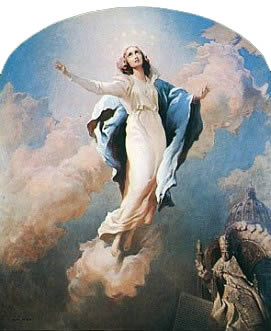 There
are some random matters to which we should tend, based on the input of readers.
There
are some random matters to which we should tend, based on the input of readers.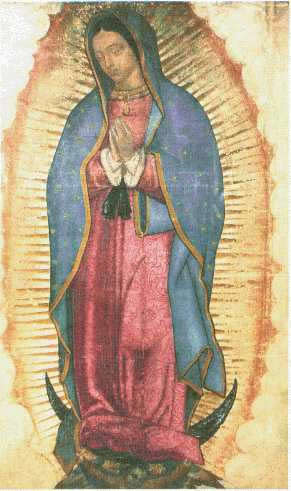 "Please recall that Our Lady called
herself Guadalupe (possibly) because in the native tongue it meant 'Who
crushes the serpent' (
"Please recall that Our Lady called
herself Guadalupe (possibly) because in the native tongue it meant 'Who
crushes the serpent' ( "Starting in Psalms 110:1, the idea of Jesus seated in Glory and the work of the
church and Our Blessed Mother going on here on earth is repeated at least six times
in the New Testament. Psalms 110, entitled 'The Priest Messiah,' says
'Yahweh declared to my Lord,
"Take your seat at my right hand, till I have made your enemies your
foot stool' (New Jerusalem Bible)."'
"Starting in Psalms 110:1, the idea of Jesus seated in Glory and the work of the
church and Our Blessed Mother going on here on earth is repeated at least six times
in the New Testament. Psalms 110, entitled 'The Priest Messiah,' says
'Yahweh declared to my Lord,
"Take your seat at my right hand, till I have made your enemies your
foot stool' (New Jerusalem Bible)."'