
When one thinks of potential coming events—chastisements, if you will—what comes to mind usually are major geophysical disturbances, mega-storms, asteroids, tsunamis, volcanoes, heat waves and the like.
These certainly may be in the cards.
But a clear and present danger is rarely considered: That’s a nationwide blackout. Cascading electrical outages.
Take a moment and mentally list all the ways you used electricity. It’s not dark fantasy.
Perhaps you’ve been through hurricanes or other events that caused temporary outages. These usually last a day or two, sometimes a week, in very severe cases (such as Cedar Key after a hurricane two years ago, or Montreal after a 1998 ice storm, during which temperatures led to some residents burning furniture in their fireplaces to keep warm) a more extended period.
In a few parts of Montreal, power wasn’t restored for months.
Those are localized occurrences.
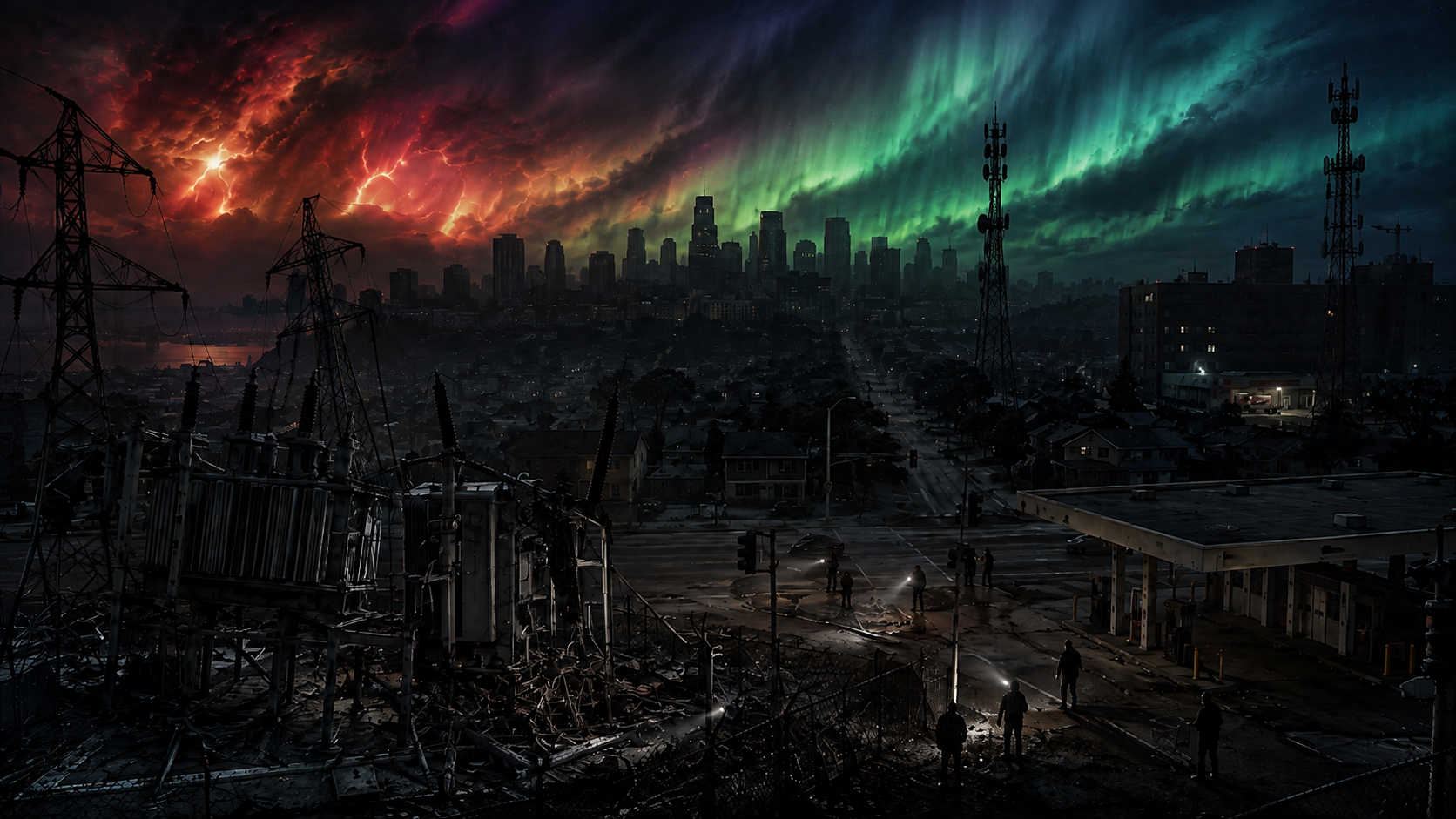
But whether by something such as a great solar storm or hacking by terrorists, there is a possibility of entire nations going dark.
The United States power grid is at risk of a major blackout that could last up to eighteen months, according to a new report. Concerns have been heightened because one U.S. city has been without power for more than a week. The New York Times Magazine recently ran a major article raising the alarm.
If similar incidents targeted the nine most important substations in the country’s three sections (Western, Eastern and Texas Interconnections, where substations are where multiple high-voltage lines meet, routing electricity between power plants, transmission lines, and local neighborhoods, “you can black out the entire United States,” said Jon Wellinghoff, former chair of the Federal Energy Regulatory Commission, who was “astounded” by a recent analysis.
A coordinated cyberattack targeted roughly thirty sites connected to Poland’s power grid earlier this year.
There have also been suspicious outages in drinking and wastewater-treatment facilities in the U.S. Federal and state authorities are investigating a series of coordinated cyberattacks targeting drinking and wastewater treatment facilities across the U.S.
Threat groups with suspected links to Iran have targeted vulnerable programmable logic controllers, the devices used to monitor and control various industrial systems, including those of water utilities.
Utilities in at least twelve states have been impacted by the attacks, including Michigan, Georgia, South Dakota and New Jersey.
The first public discovery of this threat began in Minnesota, where more than thirty community water systems were targeted in a “coordinated attack” from July 26-27.
Wellinghoff first raised the alarm in 2013 after gunmen shot up seventeen transformers at an electrical substation near San Jose, California. He frets that even teenagers with enough computer savvy could trigger a massive blackout, never mind hackers from Russia, North Korea, China, or Iran.
America’s infrastructure is badly outdated and thus vulnerable to an even larger, coordinated attack. Below is part of the chaos in New York City that followed a relatively brief outage in 1977:

Both Gary, Indiana, and Phoenix, Arizona, were hit by severe weather systems in mid-August 2026, causing widespread, damaging blackouts.
As the newspaper points out, many don’t realize that, due to our aging electrical grid, a national outage, if severe enough, could last for years.
Historically? On March 13, 1989, a geomagnetic storm caused the Hydro-Québec grid to collapse, leaving about six million people without power for roughly nine hours. The storm also produced problems in U.S. power systems.
Worst scenario: A multi-regional blackout collapses the Eastern and Western Interconnections. Because custom ultra-high-voltage transformers take months or again years to manufacture and ship, recovery theoretically could stretches past a year in heavily hit zones.
At first, it might not seem catastrophic. The lights would go out. Air conditioners would stop. Computers and televisions would shut down. Most people would probably assume the power would return within several hours, as it usually does after a storm or equipment failure. There might even be a brief sense of adventure or novelty, much as there was during the huge Northeast blackout of 2003.
But everything would change once officials acknowledged that this was not an ordinary outage and that restoration might take weeks or even longer.
For a short time, essential facilities could continue functioning on their own emergency power.
Hospitals have generators. Water and sewage facilities maintain backup systems. Certain emergency radio stations are specially equipped to continue broadcasting during a national crisis and can maintain substantial fuel reserves.
But backup systems are temporary [see article here].

Generators consume diesel. Fuel supplies must be replenished. Gasoline stations require electricity to operate their pumps, while parts of the natural-gas system also depend upon electrically powered equipment.
As those systems began failing, the situation would become far more serious.
One of the largest challenges would be restarting power plants after a complete collapse. Many generating facilities require outside energy or stored fuel to begin producing electricity again. If transportation, fuel distribution, and portions of the gas network were also disabled, restoring the grid could become enormously complicated. [scroll for more:]
And that is where the dominoes would begin falling.
Within days, food distribution could deteriorate.
Gas stations would cease operating normally.
Cellphone towers would eventually exhaust their backup power.
Internet service would disappear.
Television broadcasting would diminish or cease.
Electronic banking and credit-card transactions could become impossible.
Then would come perhaps the most unpredictable element of all: human behavior. Once large populations realized that food, water, fuel, medicine, money, and communications were no longer readily available, fear could spread rapidly.
Police and firefighters would face the same shortages as everyone else.
Communities accustomed to receiving almost everything through vast computerized supply chains would suddenly discover just how little is actually stored locally.
We surround ourselves with extraordinary technology. Amd nearly all of it rests upon one invisible foundation: electricity. Without that foundation, much of modern life becomes useless with astonishing speed.
It is no longer merely a convenience. Electicity has become something resembling the nervous and circulatory system of civilization. Remove electricity long enough and the failures begin feeding upon one another.
The disturbing prospect is not necessarily that civilization would disappear overnight. Rather, it’s that within only a matter of days, many of the systems we assume will always be there could begin coming apart. This would begin a breakdown, gradual but eventually game-changing.
Sobering was what we call the 1990 (anonymous) prophecy, which included these words:
“You think of the changes in very simple ways, without realizing the fundamental mistakes of mankind.
“The very artifice of your societies is false and against the accordance of God’s Will.
“This artifice shall not last.”
[resources: Tower of Light]