
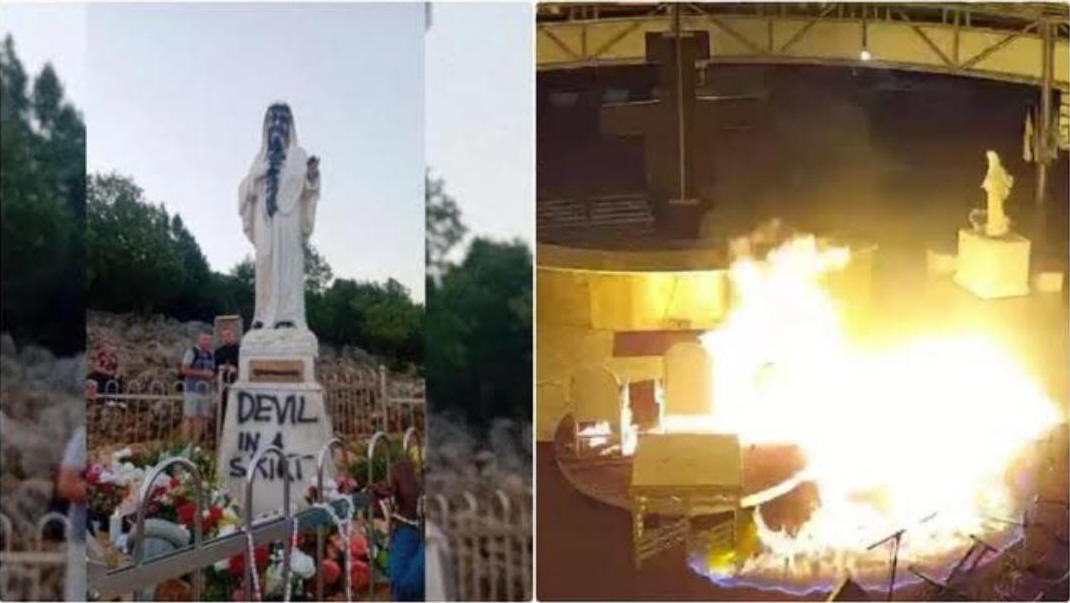
There was a different feel to the vandalism attack on several sites at Medjugorje early Tuesday, a feeling that something sacred had been not just damaged but spiritually breached.
The apparition site had made it through the war between Croatians and Serbians in the 1990s, had escaped any damage despite villages and towns nearby sustaining major attacks. Mortars from Mostar were audible at night, rattling windows in Medjugorje but not touching the actual site.
Two bombs were dropped during that war, one falling right next to Saint James Church, but miraculously failing to detonate.
 After the horrendous conflict, a Serbian pilot described his attempt to drop bombs on the area but his plane had suddenly and mysteriously been encompassed by a cloud or fog that stripped away all visibility, causing him and others to abort the mission.
There was that. There were attempts in the earliest days by Communists to shut Medjugorje down. There was a vehement attempt by a local bishop to stop the apparitions.
But Medjugorje prevailed each and every time.
And will do so now; even as this is written, the statues blackened with demonic paint already have been cleansed. They will end up looking brighter than ever.
And thankfully, a fire set on the very altar of the huge exterior church adjacent to and behind the original Saint James has not caused ruination and likewise repairs and cleaning-up were immediately underway.

But there was the feeling that a boundary had been crossed. The damage was right there at the very first spot of apparition on June 24, 1981.
Reportedly, there was also vandalism nearby at another spot Mary favored marked by a blue Cross. As far as we know, there was no damage on Mount Krizevac, the famous mountain there.
Nonetheless, millions of faithful around the world were shaken by the events, which even made headlines on the Vatican’s website.
An unconfirmed Facebook post says it was the work–astonishingly enough–of a lone vandal from Poland who had been a pilgrim to the shrine but for reasons unknown was overtaken by darkness.

“The story of a young Pole, Bartek Krakowiak, who walked over 4,500 kilometers from Warsaw to Medjugorje a few years ago, touched the hearts of believers all around the world,” says the translated post. “His pilgrimage was a symbol of unwavering faith, love for the Blessed Mother, and a desire to make a sacrifice rarely seen! That is why today’s news has left many speechless. It is hard to believe that the name of a man who once inspired thousands of people with his testimony is today linked to an act that deeply shook Medjugorje and all believers!” [see story here]
Noteworthy was the Virgin latest monthly message at Medugorje on July 25: “Dear children! While darkness and peacelessness rule in many hearts, you, little children, be prayer and my extended hands of love. Little children, place the Sacred Scripture in a visible place in your family and read it, so that it may be an encouragement for you to conversion and a new life; because Satan is strong and seduces hearts. Your hearts, through my maternal Heart, I desire to commend to the Heart of my Son Jesus, so that He, the Risen One, may reign in you and joy may begin to reign in you and around you. Thank you for having responded to my call.”
On the wider stage, the vandalism is one of many recent assaults. CatholicVote has tracked acts of hostility, vandalism, and arson directed specifically at Catholic churches in the U.S. in over five hundred distinct incidents since May 2020.
Worldwide, attacks have been at least as numerous, especially in France, though not at major shrine there such as Lourdes.
The fire that destroyed much of Notre Dame Cathedral in Paris was blamed on workmen but one still wonders about its origin. In 1972, Michelangelo’s famous Pieta was attacked inside Saint Peter’s at the Vatican by a madman with a hammer, causing extensive damage.

The Church is certainly used to vandalism.
As Rafael Villongco pointed out on a podcast, “Mary, Refuge of the End Times” [his Facebook page is here], apparitions in Rwanda at a small hamlet called Kibeho first began in November of 1981 after a series of vandalisms at Catholic churches across that African nation.
The Kibeho appearances of Mary—fully approved by the Vatican—warned of coming conflict if there was not massive conversion, and indeed, twelve years later came a horrid genocide in which 800,000 Tutsis were slain by Hutus in a gruesome civil war.
If there is any parallel, a new stage will now be revealed with Medjugorje, and if there is that parallel, without conversion there will be conflict or some form of upheaval and disaster in the coming years or months that dwarfs what is currently seen.
–-MHB