
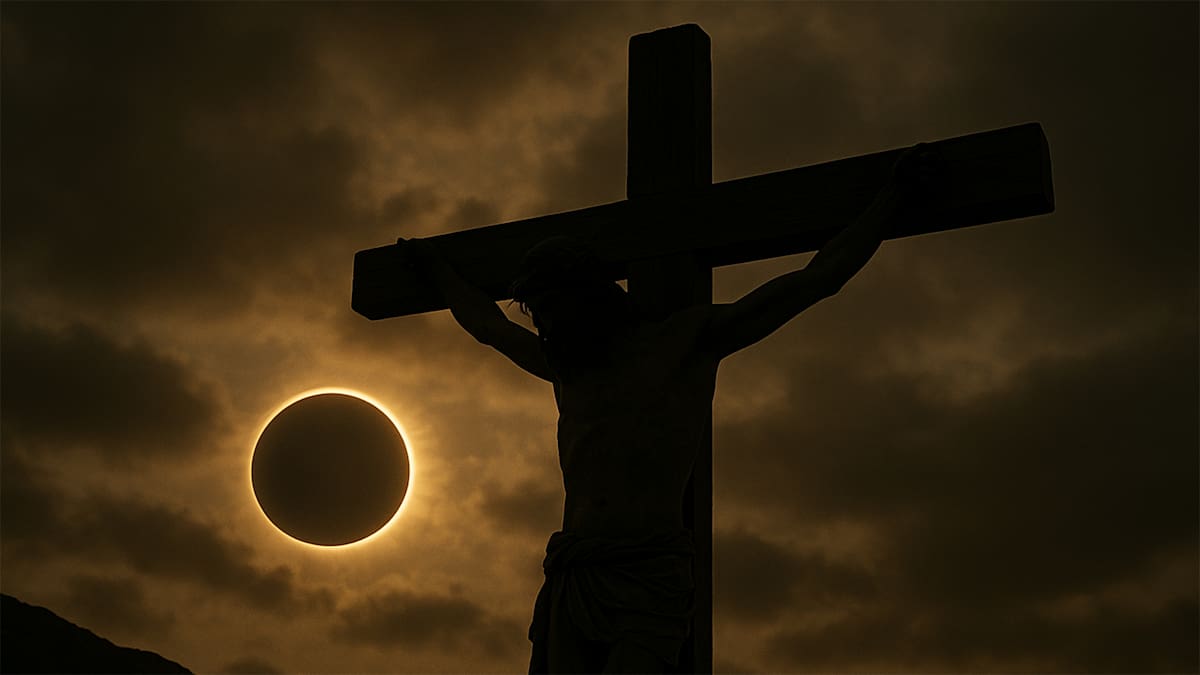
For centuries one of the great questions has not merely been whether Jesus died for mankind, but precisely when He died.
Scholars, historians, astronomers, and biblical experts have all tried to pin it down. And while there’s anything but absolute unanimity, the evidence narrows dramatically to just two main possibilities.
The most likely date, many scientists seem to believe, is Friday, April 7, 30 A.D.
The chief alternative: Friday, April 3, 33 A.D.
We have to go with the second option, birth at the very onset of a millennia and death at the age of thirty-three.
Besides, the persistent 33 A.D. seismite (sedimentary beds and structures deformed by seismic shaking) indicates the biggest 33 A.D. earthquake was a magnitude-6 earthquake that likely occurred—catch this—April 3, 33 A.D.
That’s geologists speaking. The quake startled city residents and caused moderate damage, especially to the western side of Temple Mount, which now finds itself in the midst of a great conflict.

Why those two dates?
Because Scripture, history, and even astronomy converge in a remarkable way.
We know from the Gospels that Jesus was crucified under Pontius Pilate, the Roman governor of Judea. Pilate ruled from 26 to 36 A.D. That gives us the first boundary.
We also know the Crucifixion took place around Passover, which in turn means it occurred at the time of a full moon.

And there is the crucial point: whatever the darkness was that came over the land during the Crucifixion (Matthew 27:45, Mark 15:33, Luke 23:44-45), it could not have been a normal solar eclipse, because a solar eclipse occurs at new moon, not full moon. Passover is tied to the full moon. So whatever happened that afternoon was something else—whether a dense atmospheric event or (as we certainly opt for) some extraordinary Providential phenomenon.
Once scholars combine the biblical requirement of a Friday, the historical requirement of Pilate’s governorship, and the calendar requirement of Passover, the field becomes surprisingly narrow. It comes down mainly to those two dates: April 7, 30 A.D., and April 3, 33 A.D.
Why do so many lean toward 30 A.D.?
Partly because the chronology of Jesus’ ministry seems to fit here as well. Luke tells us that John the Baptist began preaching in the fifteenth year of Tiberius Caesar. Jesus’ public ministry followed soon after. Depending on how one counts the Passovers mentioned in the Gospel of John, His ministry appears to have lasted more than a single year and perhaps around three years or somewhat more.
That leaves room for either 30 or 33, but many scholars believe the overall historical fit is slightly cleaner with 30 A.D.
There is also the matter of age. Jesus was “about thirty” when He began His public ministry. If He was born a few years before the death of Herod the Great—as many historians think—then a crucifixion in 30 A.D. sits very naturally within that framework.
What about 33 A.D.?
It has stronger evidentiary support. In fact, even some scholars favor it because it can fit a somewhat longer ministry and because the Passover calculations line up impressively. It is by no means a weak theory. If someone argued for April 3, 33 A.D., they would be standing on serious historical ground.
It is striking that the death of Christ is not left floating in myth or vague symbolism. It anchors itself in real time—under a known Roman governor, during a known Jewish feast, at a moment that can be approached through actual calendars and celestial patterns, during a documented quake.
And an eclipse.
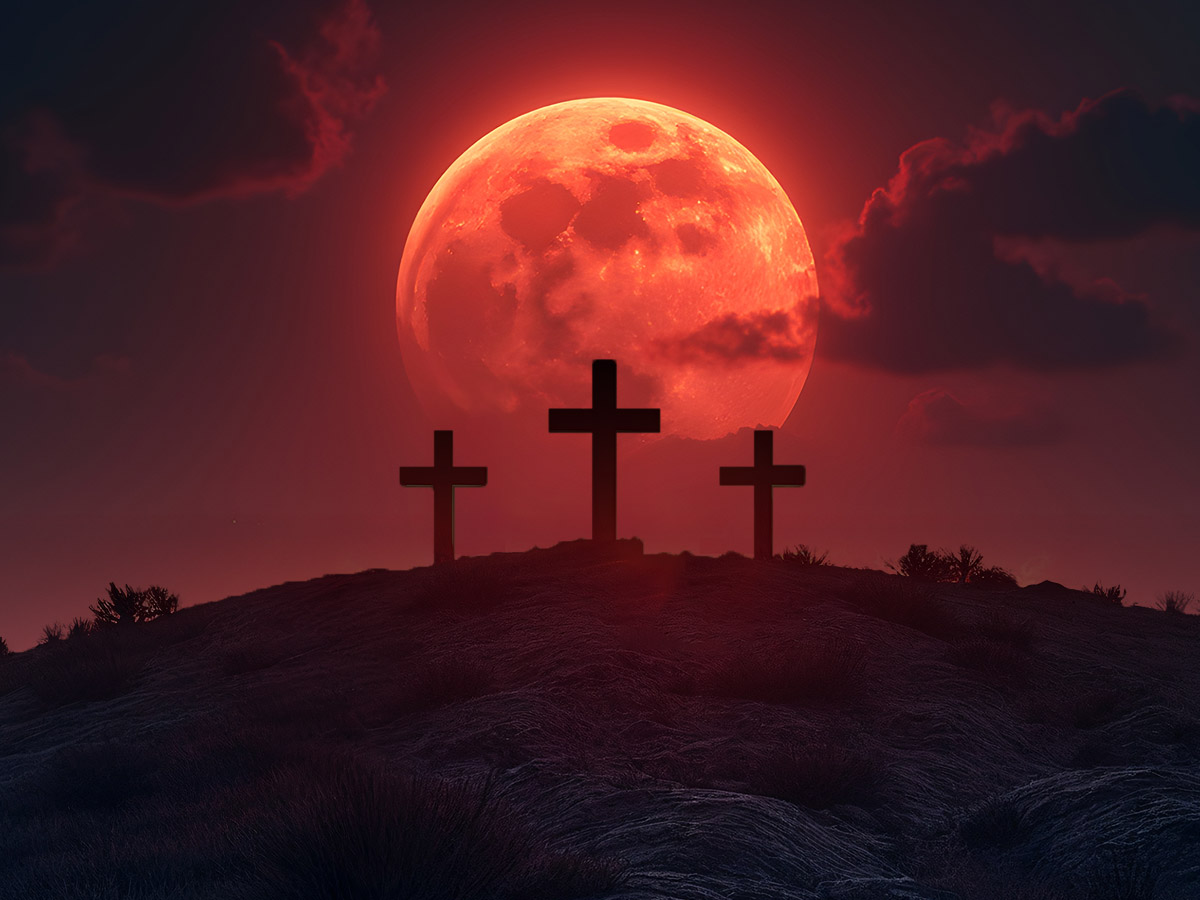
This in our view is a clincher: A partial lunar eclipse was visible from Jerusalem shortly after sunset on Friday, April 3, 33 A.D.
The event, sometimes referred to as a “blood moon,” aligns with biblical descriptions (Acts 2:20, Joel 2:31) of the moon turning red, remarkably linking astronomical data with the aftermath of the Crucifixion.
The Crucifixion is not merely theology. It is theology entering history.
And perhaps that is the deepest point.
The Son of God did not die in some legendary once-upon-a-time. He died on a real Friday, in a real province, under a real governor, at Passover, while the world turned as it always had—except that, at that moment, everything changed.