
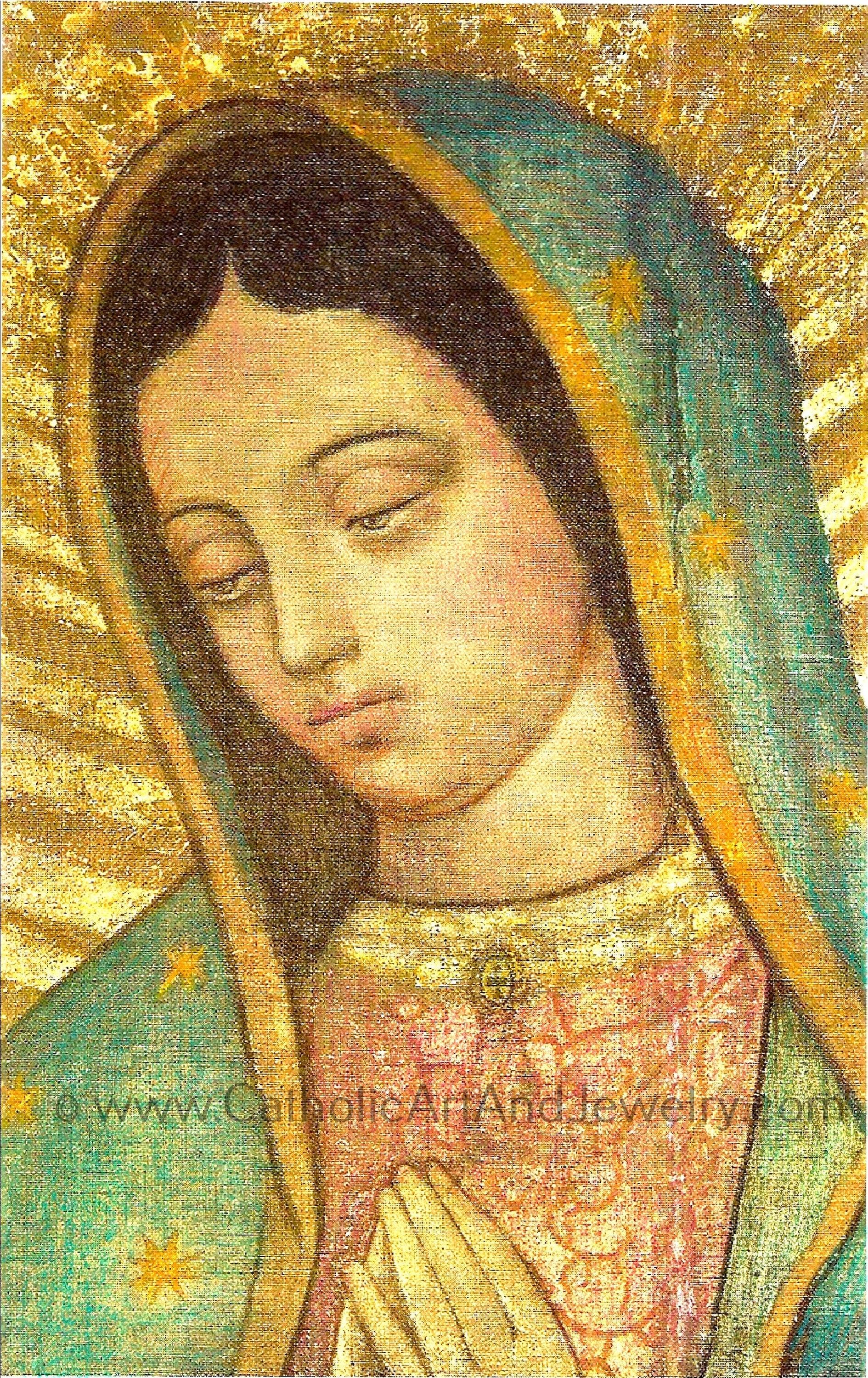
The tilma itself should have been the first thing to decay. Woven from coarse agave fibers, such a garment has a natural lifespan of perhaps twenty to forty years, and far less when exposed to humidity, smoke, and handling. For more than a century after the apparition, the tilma hung openly in a small chapel, without glass, breathing the moisture of countless pilgrims, absorbing candle soot, and subject to the elements. Yet it has not frayed, unraveled, or shown the kind of decomposition that any expert in textiles would expect.
When researchers recreated an identical fabric and placed it in similar conditions, it deteriorated rapidly. The tilma also survived two dramatic assaults that should have destroyed it: a nitric acid spill that mysteriously stabilized itself rather than eating through the cloth, and a bomb explosion in 1921 that shattered the marble altar and twisted a bronze crucifix but did not even crack the thin protective glass over the image.
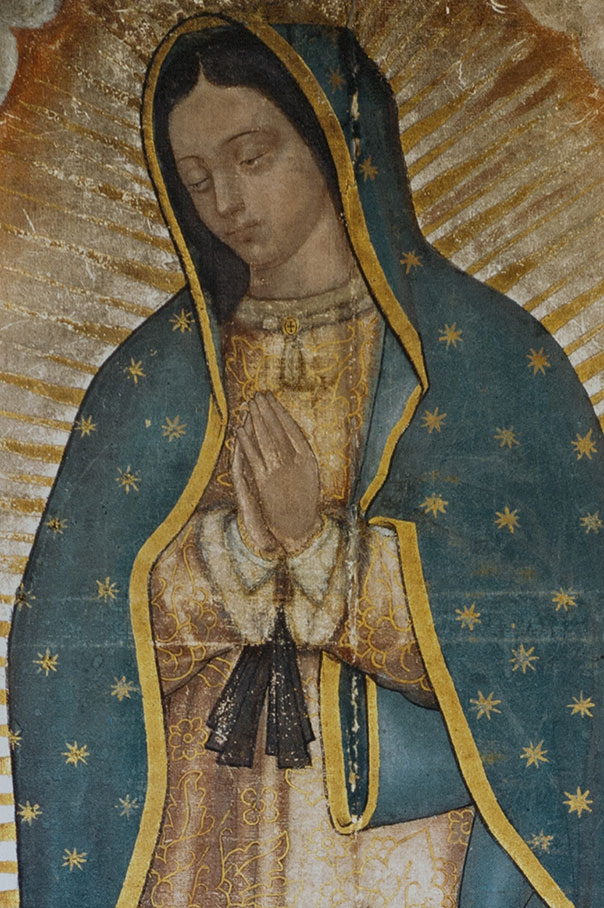
The image itself defies artistic classification. Modern imaging techniques—infrared photography, ultraviolet scanning, and digital magnification—have shown that the coloration does not penetrate the fibers like dye, nor does it sit upon them like paint. There are no brushstrokes, no sketches beneath the surface, and no outlines. Under magnification, the colors seem to hover slightly above the threads, as if suspended in a way no printing or painting technique can replicate. Some pigments do not match any natural substances from the Americas or Europe, most notably the unique turquoise-blue of the mantle, a shade considered royal in Aztec symbolism but unattainable with available pigments in the 16th century. Again and again, experts are left with the same conclusion: this is not the work of human hands.
Even more astonishing are the eyes. Ophthalmologists studying them since the 1920s have discovered optical phenomena present only in living eyes. Reflections appear within the irises—tiny, detailed images showing what would have been before Mary at the moment Juan Diego unfurled his cloak, including human figures and spatial depth. These reflections obey the Purkinje–Sanson effect, a series of optical reflections from the cornea and lens that require knowledge of ocular physiology entirely unknown in 1531. The curvature of the cornea is correct. The reflective geometry is correct. The eyes behave, under magnification, like the eyes of a living person. To embed such effects on a rough, woven cloak would be impossible for any artist, let alone one of the 16th century.
 Researchers have also found that the image communicates across cultural, astronomical, and symbolic dimensions. Astronomers noted that the stars on Mary’s mantle correspond to the constellations visible over Mexico City on the winter solstice of 1531, an astronomical snapshot encoded in the garment. For the indigenous people, every element of the image conveyed profound meaning: the black ribbon symbolized pregnancy; the four-petaled flower over the womb indicated the divine center; the turquoise mantle signified royalty; and her stance over the moon proclaimed the triumph of the true God over the pagan gods of night and death. The entire image functioned as a visual gospel, perfectly crafted to speak simultaneously to Spaniards and Aztecs. No painter could have created such depth of meaning, accuracy, and cross-cultural precision. [scroll for more:]
Other subtle anomalies have been observed by researchers—qualities that enhance the image’s sense of being “alive.” The tilma maintains a temperature similar to that of a living human body. Medical instruments placed over the womb area have registered rhythmic sounds reminiscent of a fetal heartbeat. Digital analysis reveals mathematical harmonies and golden-ratio structures encoded across the image, patterns that occur naturally in creation but not typically in hand-painted works, especially on uneven cloth.
Beyond the scientific mystery, the image’s historical impact is perhaps the most miraculous dimension of all. Within seven years of Guadalupe, nine million indigenous people embraced Christianity. The conversion was unprecedented in speed and magnitude, effectively reshaping the spiritual landscape of an entire continent and ending the long cycle of ritual human sacrifice. No missionary strategy, no human plan, could have produced anything like it. The conversion bore the unmistakable imprint of divine intervention.
The message of the apparition reinforces the miraculous nature of the image. Mary appeared not as a European figure but as a mestiza princess, bridging two worlds during a time of deep conflict. She spoke to Juan Diego with gentleness and familiarity in his own language, offering the timeless reassurance, “Am I not here who am your mother?” Everything about the apparition—its timing, its tenderness, its symbolism, its impact—has the touch of Heaven. It is a miracle not only of image, but of presence.
For believers, the tilma is a gift meant for healing, unity, and faith. For experts, it remains an artifact that withstands every attempt at natural explanation. And for the world, it stands as a quiet yet powerful reminder that God often enters history through signs of beauty and maternal love—signs that endure, unchanging, for centuries.
+