
From Excerpts taken from Praying with the Saints for the Holy Souls in Purgatory by Susan Tassone:
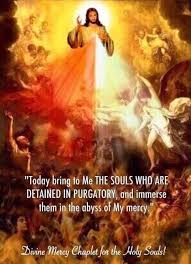
TODAY BRING TO ME THE SOULS WHO ARE IN THE PRISON OF PURGATORY
St. Faustina Kowalska is known today as the “Apostle of Mercy.” She was consigned the great mission by Our Lord to proclaim His message of mercy to the whole world by her example, suffering and obedience and by recording everything in a diary. Our Lord requested the feast of Divine Mercy be celebrated on the Second Sunday of Easter.
Jesus told St. Faustina: “On that day the very depths of My tender mercy are open…The soul that will go to Confession, and receive Holy Communion shall obtain complete forgiveness of sins and punishment. On that day, all the divine floodgates through which graces flow are opened. (Diary, 699). Jesus himself asked her to devote the eighth day of the Divine Mercy Novena to praying for the release of the souls in purgatory. (Diary, 1226).
St. Faustina was known to be a saint of mercy for the souls in purgatory. One night she was visited by the soul of a fellow religious who had recently passed away. In
her diary she described the poor soul as being “in a terrible condition … her face painfully distorted.” She redoubled her prayers for the sister’s soul.
Sometime later, the soul of the sister again visited St. Faustina during the night. Her face was now “radiant, her eyes beaming with joy.” She said that Faustina had a true love for her neighbor and that many other souls had profited from her prayers.” Before the soul left, she urged St. Faustina “not to cease praying for the souls in purgatory” (Diary, 58).
Remember, this includes Indulgences! Jesus said: “Draw all the indulgences from the treasury of My Church and offer them on their behalf.” Offer your Indulgence for the holy souls or a specific soul on Divine Mercy Sunday. You will not lose the grace of the indulgence! Our Lord told St. Gertrude who offered all her merits for the dead: “What can I do more for one who has thus deprived herself of all things through charity than to cover her immediately with charity?”
When St. Faustina was visited by another fellow sister in purgatory, the soul bid her to have one Mass offered for her and three ejaculatory prayers (Eternal Rest prayer) because Mass is the greatest means to help such souls reach God. Jesus gave St. Faustina an intense yearning for him in Holy Communion to help her
understand “what the longing of the souls in purgatory” is like. On July 10, 1937, St. Faustina attended Holy Mass experienced “such intense hunger for God” that she seemed to be dying of the desire to be united with Jesus.” She explained that only the night before, she had been fasting and offering all her spiritual exercises for one of the deceased sisters (Diary, 1185-86).
In the vision of purgatory, St. Faustina asks the holy souls what their “greatest suffering” is. In one voice, they answer that it is their “longing for God” (Diary, 20).
During a family gathering, St. Stanislaus Papczynski, the founder of the Marians of the Immaculate Conception, saw the suffering souls in purgatory, got up from the table and in his
haste to go to the chapel to pray for them, walked right through the table. “Pray brethren, for the souls in purgatory, for they suffer unbearably,” he told his confreres
later. Then he locked himself in his cell for three days and prayed for those souls yet more. It is believed that many of the fallen soldiers appeared to him for help. People were dying by the thousands and so often going unprepared before God — very much like our times. Father Stanislaus decided that helping the souls of the dead especially those who perished during a war or pestilence, should be the key goal of his congregation. To this day, the second special calling for the Marian Fathers is to “offer our lives for the holy souls in purgatory, especially the victims of war and disease.”
Let us follow their ways! Offer Gregorian Masses for your deceased loved one. Offer a novena of Masses (nine days). A Triduum of Masses, (3 days) or individual Masses. Contact
the Pious Union of St. Joseph, www.pusj.org. These Mass stipends support our Catholic Missionary priests who serve in the most remote and poorest countries around the world.
Remember to offer Masses for yourself while you are alive. A living person, is still capable of growing in sanctifying grace. The Mass heals the living and the dead.
Put Gregorian Masses in your Will. With so many families only arranging a prayer service for their deceased loved ones, omitting a funeral Mass, you need to be sure Masses will be offered for your soul!
I noted in my years of research that many souls appear first to those closest to them for help. As in the case of St. Faustina, the nuns she lived with and with St. Padre Pio the monks he lived with. In my own experience deceased relatives and family members appeared in dreams to myself and siblings seeking help and confirming they are okay but need prayers, especially the Mass. The Mass is the most powerful means to relieve and release them. Let us pray as St. Faustina prayed on the eighth day of the Divine Mercy Novena:
“Eternal Father . . . look upon the souls in purgatory in no other way than the wounds of Jesus, Your dearly beloved Son; for we firmly believe that there is no limit to Your goodness
and compassion” (Diary, 1227).
© Excerpts taken from Praying with the Saints for the Holy Souls in Purgatory, (OSV).