|
 The
Imitation of Mary, by Abbe
Alexander de Rouville. No sooner had the incomparable Imitation of Christ
appeared than the faithful began to spontaneously wish for an imitation of Our
Lady, and finally, in 1768, a monk pulled together a little powerhouse of
meditation on the different mysteries and circumstances of her life, from the
Immaculate Conception to her Assumption into Heaven!
Click here The
Imitation of Mary, by Abbe
Alexander de Rouville. No sooner had the incomparable Imitation of Christ
appeared than the faithful began to spontaneously wish for an imitation of Our
Lady, and finally, in 1768, a monk pulled together a little powerhouse of
meditation on the different mysteries and circumstances of her life, from the
Immaculate Conception to her Assumption into Heaven!
Click here
|
|
|
|
|

__________________________________________________
NOTRE DAME THEOLOGIAN CITES FACTORS IN
MODERN CHURCH THAT SQUASH REVELATION
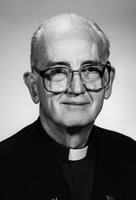
A theology professor from the University
of Notre Dame
has taken sharp issue with the suppression of prophetic gifts in the
modern Church -- blaming extremes in both liberal and conservative factions.
The professor, Father Edward D. O'Connor,
says in a new book, I Am Sending You Prophets, that friction between
prophetic and institutional sides of the Church -- as well as the resistance of
priests to laymen who appear to possess special "gifts" -- has
all but eliminated practices that were common in the Church's first two
centuries and practiced by Jesus.
"Among those who are particularly
skeptical are many faithful Christians -- obedient, pious, zealous, generous,"
writes the professor. "They call themselves conservatives and indeed they are.
Their idea of fidelity consists in staying with the tradition of the Church,
submitting to its judgment in everything.
"They do not reject
prophecies, revelations, or apparitions on principle, but they are uneasy
about such manifestations until these have been stamped by the Church with an
official Church approval. Not trusting their own discernment, they want to wait
on the Church's judgment and follow it. They gladly honor the approved
apparitions of Lourdes, Fatima, and the like, but are unwilling to pay attention
to those which have not yet been officially endorsed.
"Such reverence for the Magisterium is in
many ways admirable," Father O'Connor goes on. "However, these people are
cutting themselves off from some of the most delicate graces of the Holy Spirit,
Who does not confine His activity to acts officially approved by the Church. He
is present, in touch with us and constantly active in our lives. He has things
to say to us, sometimes by interior inspiration, but also sometimes by prophetic
messages, extraordinary signs, or apparitions of Jesus, Mary, and the saints."
On the opposite end of the spectrum but
equally opposed to apparitions are "progressives" and liberals who are not as
faithful to the Magisterium and reject locutions and apparitions precisely
because such revelations often seem to reinforce the more conventional and
traditional practices of the Church, as well as condemn modern forms of sin.
It is a tricky, sensitive
topic at a moment in history when obedience to the Church is
critical -- a safeguard against false (and even demonic "revelations") -- while at
the same time there often has been an exclusion of the very supernatural
phenomena on which the Church is founded, asserts Father O'Connor.
"To out off these graces until they have
been officially approved by the Church is in effect to close oneself to them,
because it is simply impossible for the Church to investigate them all; and the
few that are investigated are seldom approved until long after they have taken
place," writes the prominent theologian.
"Even the prophecies of Scripture were
not, at the moment they were given, approved by religious authorities," he continues.
"When Moses heard the Lord speaking from the burning bush; when Isaiah or
Ezekiel received their visions; when the angel Gabriel spoke to Mary, or the
Lord to St. Paul on the way to Damascus, the recipients had to judge on the spot
whether this was from God. If they had postponed their response until the
hierarchy gave its imprimatur, the grace of these messages would have been lost.
"To quote Father John Mary: 'If the
shepherds at Bethlehem had waited for the approval of the Temple authorities,
they would never have seen the Infant Jesus.'"
The book,
which has chapters on many historic mystics, notes the
irony that while some conservatives avoid current manifestations of the
supernatural -- saying all they
need is Scripture and the sacraments -- many mystical experiences greatly
strengthen precisely these aspects of Catholicism. "Mary frequently
urges people to read Scripture, whereas the very people who claim that Scripture
suffices frequently don't read it very much," the priest claims. "At Medjugorje people go to
Confession and Communion far more frequently than at most other places in the
world. The people who make pilgrimages to Medjugorje have found their love of
Scripture and devotion to the sacraments intensified there.
"In other words, Our Lady's
apparitions lead the people who listen to her to profit by Scripture and the
sacraments more than do many of those who claim that Scripture and the
sacraments suffice," the priest charges.
Let us interject
that while it indeed has been noted in virtually every diocese that those following mystical
currents tend to visit Church more frequently, caution is in order because there have
been dozens if not hundreds of instances in which the faithful have been
led astray or ensnared by falsity -- pointing out the need for careful balance between
over-belief and accepting too little.
It is important, agrees the theologian, "to
stay within the guidelines furnished by the Magisterium."
Father O'Connor, who discusses cases from
the Old Testament ones to more recent ones such as St. Hildegard, Bridget of
Sweden, Anne Catherine Emmerich, Mary of Agreda, and Fatima, as well as
Medjugorje, says that it was the rise of exaggerated and false prophecy in the way of Montanism
that began the decline of
charismatic dominance.
As a result,
an institutional
structure was put into place to
control precisely such renegade prophecy and has now reached the point, argues
the scholar, where that structure now
precludes legitimate spiritual gifts. The "age of the prophets" ended during the second
half of the second century (a fact discussed as long ago as the fourth century,
he notes, by St. John Chrysotom).
"This is one of the worst aspects of
clericalism -- forgetting that it is the Holy Spirit, and He alone, Who
sanctifies and inspires the faithful," says the priest.
"The priest is charged with the ministry
of the sacraments, and with discernment of the graces received by the faithful;
but in all this, he is only a servant, not an executive," writes Father
O'Connor. "Luke 7:30 declares
flatly that the pharisee and scholars of the law who refused to be baptized by
John the Baptist 'rejected the Plan of God for themselves.' Could the same be
said today of the clergy who refuse to pay attention to those through whom the
Lord is speaking now?"
Father O'Connor says that the notion has
grown that the time of Divine
revelation is past, exhausted by the Apostles nearly 2,000 years ago -- despite Scriptural
teachings "that prophecy is a permanent gift to the Church."
He further argues
that both John Paul II and the Second Vatican Council reiterated the
responsibility of those in pastoral positions "not to extinguish the Spirit"
(as St. Paul put it).
He points
out that the Divine Office which priests and religious pray each day opens with
Psalm 95: 'If today you hear His voice, harden not your hearts.'"
He also cites famed theologian Karl Rahner as averring that
"there is a jealousy on the part of the institutional Church regarding the
'direct line to Heaven' that the prophets seem to have."
Still, let us again urge
both caution and obedience.
Whatever the personal discernments of the faithful,
priests overseeing a mystical claim should be respected, not to mention
bishops who have authority over mystical experiences (unless his authority is
removed by Rome, as happened at Medjugorje).
Obedience is more
valuable, says Scripture, than sacrifice.
Such is also an exercise in humility.
In
many cases, humbleness and obedience have prevented the faithful from exposure to exquisitely
deceptive apparitions.
But the nerves touched by Father
O'Connor's strong opinions are raw ones at a time when diocese after diocese in
the U.S., Canada, and Australia has
rejected assertions of the miraculous.
Despite its size, the United
States has no fully-approved apparition of the Blessed Mother.
"There should be collaboration between
pastors and prophets," argues the priest. "The pastor should be open to
suggestions, leads, inspiration from the prophets. The prophet should be
deferential to the pastor's authority.
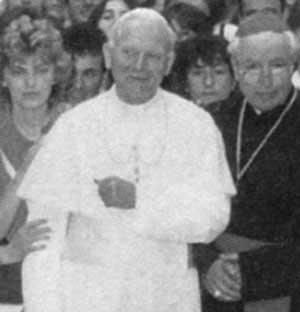 That appears to have been
the modus operandi of John Paul II, a Pope who was cautious and
traditional and yet
staunchly promoted mysticism, including Medjugorje.
That appears to have been
the modus operandi of John Paul II, a Pope who was cautious and
traditional and yet
staunchly promoted mysticism, including Medjugorje.
Indeed, the pontiff met dozens of alleged seers during his pontificate, some at
general audiences, some privately.
The current Pope, while less mystically inclined, has noted that "one of the
signs of our times is that the announcements of 'Marian apparitions' are
multiplying all over the world."
"The journalist [Vittorio] Messori, while
interviewing Pope John Paul II, asked why God doesn't 'give everyone more
tangible and accessible proof of his existence," notes Father O'Connor. "A year
or two after his book was published, he had to report on the statue in Civitavecchia
[Italy] that wept tears of blood in the hands of the local bishop!
"Similarly, a priest I know lets out a
huge belly laugh whenever anyone speaks seriously about the apparitions at Medjugorje or elsewhere. Yet one morning at breakfast, he complained that God
keeps Himself too hidden -- that He ought to give more signs of His Presence."
Another argument of skeptics, points out
Father O'Connor: the Bible passage that says not to seek after signs. "But the issue here is not about seeking
new marvels, but about recognizing and profiting from those which God has given
us on His own initiative," he answers.
Meanwhile, liberals or "progressives" see
mysticism as a fall back into the bad old pre-scientific days. Or they are concerned about the
conservative nature of the messages -- which frequently warn against such things
as abortion, divorce, and sexual impurity.
"In conclusion, however one may account
for it, the sense of prophecy as an ongoing, active charism has been lost from
the general consciousness of the Church over the course of the ages," says
the priest. "The reasons I have proposed to explain this include concern for
illusion, clericalism, exaggerated traditionalism, 'experimentalism,' and other
factors."
Father O'Connor quotes The Imitation of
Christ, a classic revelation in which the Lord
allegedly told a monk, "I have instructed my prophets from the
beginning and even to the present time I have not stopped speaking to all men,
but many are deaf and obstinate in response. Many hear the world more easily
than they hear God."
[resources
I Am Send You Prophets and
The Day Will Come]
E-mail this
link directly

Return
to home page www.spiritdaily.com